CHAPTER SIX
Thinking about the tactics used in the murder of the three drug dealers, Eva decided that she wanted some professional insight. She contacted one of the two ESU supervisors that are constantly patrolling Brooklyn and asked to meet up with him. She was told it was no problem as long as nobody decided to jump off a building or barricade themselves in an apartment today.
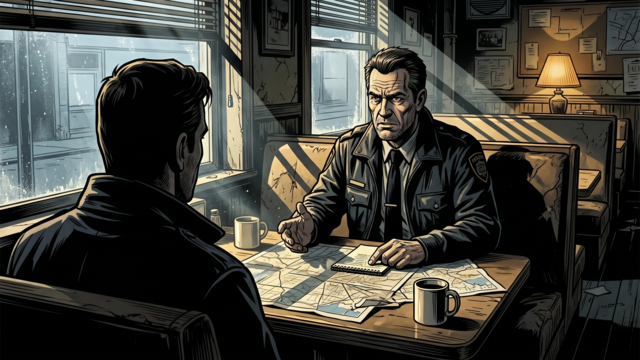
About an hour later, she was sitting down with Lieutenant Jamison from Emergency Services Squad Eleven. They met at an old-fashioned coffee shop. She explained the whole situation, including all the things that were and were not found at the murder scene. However, she held back the theory that the entire thing might have been more about the victims than an actual robbery.
"Well, they certainly took an organized approach," the Lieutenant said. "But there are a lot of flaws here, too. At least from my perspective. But two things are clear. They obviously wanted the dealers. And they picked an ideal location to take 'em out."
"Why do you say that?" Eva feigned confusion. "Why not a target of opportunity, maybe a last minute thing?"
"Look," the Lieutenant said. "That's possible, but unlikely. Nobody with even the most basic training wants to raid a location spontaneously. A good breach comes at the cost of the element of surprise. So, you want to know as much as possible about the location you're entering to limit the amount of surprises waiting for you."
"So, nobody does something like this without a plan," Eva confirmed. "That would mean they had more information than we have been able to dig up, so far. How else could they have made a plan?"
"I'll almost guarantee that they did," the Lieutenant said. "People do kick off blind raids, but it's a rare occasion, where something happens, and you're forced to react to it right on the spot. Which brings me to my next point, the guys you're looking for are most likely military trained."
"Wait," Eva said. "How can you tell that?"
"The biggest clue is the double-taps, or two rapid gunshots. One shot to center mass, one shot to the head. In general, only special military units use that shooting technique."
"Okay," Eva agreed. "Does anything else obvious stand out to you about these guys?"
"Well," the Lieutenant said. "If you had enough information up front, then targeting these guys while they were inside the house would be one of the best options. To me, that denotes someone familiar with basic planning and strategy. So, again, it makes me think your suspects are ex-military."
"Seriously?" Eva was really confused this time. "With all the places that bad guys could hide, all the weapons and people that could also be inside? No matter how much information the suspects had before entering, things could still change at the last minute, or their information could just be plain wrong."
"Sure," the Lieutenant agreed. "It happens to us all the time. We get handed building blueprints that are outdated. Or, more people end up being inside than we initially thought there were. Sometimes there's a wall where a door was supposed to be. And, sometimes, you just have a mechanical failure with a breaching tool or a weapon. It's called Murphy's Law. You plan for it the best that you can, but things still happen. However, that doesn't change the fact that an ideal plan is still an ideal plan."
"I don't know." Eva shrugged. "It just seems to me easier to grab the victims one at a time rather than charge headfirst into so many potential hazards."
"That's because you're looking at it through the lens of your average street-level robbery. Consider this. If you have the place under surveillance, and you've done good reconnaissance before the raid, then you already have a pretty good idea of who and what is inside that house at any given moment. Now, consider that the house is an enclosed space that you can control, with a limited amount of variables that you can mostly predict. Contrast that to a busy city street, with many elements that you cannot control, such as weather and brain-dead citizens walking or driving in and out of your area of operation. Plus, if you take the dealers down in the house, you have even less chance of gunshots drawing attention."
"Well," Eva offered, "Our scene had an apartment building two doors down the street and a busy pizza joint on the same street. Yet, nobody heard anything close to gunshots that night."
"The suspects were probably using suppressed weapons. That would greatly reduce the noise from their weapons. Also, you said that they killed everyone that was inside, as far you could tell. So, no noises and no witnesses. Two great reasons for your suspects to choose the house instead of the street."
"Well, that might explain some things. But we still don't know if robbery was the motive or if it was something more personal."
"Must have been some pretty high-level dealers," the Lieutenant offered. "For what went down there, it doesn't sound like typical street thugs did this."
"Agreed. We don't have any fingerprints or trace evidence from around the house, except from the victims. And, other than the bullets left in the bodies, we really don't have much physical evidence at all to give us any clue about our shooters."
"I hear ya. And, I don't envy you."
"Okay, run through this with me, again." Eva began to summarize, "We can probably assume that our suspects do have some level of training. They're probably ex-military. We can also assume that they had prior knowledge that a deal was going down there. Chances are good that they did some surveillance, at least one day of it, before raiding the house. They probably used silenced weapons. And, they took deliberate steps to slow down our investigation."
"Sounds about right," the Lieutenant agreed.
"So, this question should be obvious. What are the chances that a few of your ESU guys did this?"
The Lieutenant chuckled. "Well, if my guys had done this, there would be specific clues all over the place. Everyone in the Emergency Service Unit trains to do things in a specific way. Plus, keep in mind that our guys generally have one thing in mind at the end of their tour: sleep. We have eleven Squads, touring all five boroughs of NYC, around the clock. We do everything from emergency response at construction sites to serving high-risk warrants, as well as diving the rivers, construction site accident rescue, hostage rescue, building collapse rescue, and extricating people from car wrecks. Our guys barely have the energy to get home when they're off-duty."
"Wait," Eva said. "What does specific clues all over the place mean? What specific clues?"
"Look," Lieutenant Jamison said. "On average, ESU probably does just over eight-thousand raids a year to serve warrants, retrieve suspects, or to stop emotionally disturbed people from hurting themselves. That averages to around twenty raids a day throughout the entire year. No other department or agency in the whole country has a response team that does even half of that many raids."
"Damn," Eva exclaimed. "That does sound like an awful lot of raids."
"That's because NewYork City's population is twice as large as that of almost forty states across this country. Eight million people in this city. So, of course, we have more raids. We also have more toilet flushes, more pet goldfish, and more pizza slices than anywhere else in the country. It's not a conspiracy, it's just math. More people means more everything else, including crime."
"Understood," Eva agreed. "But how does that clear your guys?"
"It doesn't," replied the Lieutenant. "But with that many raids per year, over time, we develop certain habits and actions that we don't even think about. And no amount of planning is going to overcome those habits. That means you would see certain and specific traits at your crime scene that would mimic most of our other raids. Plus, the logistics at this murder scene of yours are all wrong for our guys."
"What do you mean," Eva asked.
"Well, for one, our guys would have to spend a lot of money on their own equipment to pull this off. Just like the rest of the department, all of our equipment has mile-long paper trails. No matter what incident or training operation we are involved with, we have to account for every bullet, every ink pen, everything. If our guys did this, they would have to have had all their own gear and weapons. Our guys' equipment stays with their vehicle when they are off-duty because someone else is now driving around with it. Any missing weapons or equipment would be noticed as soon as the next shift came on duty."
"Okay," Eva said. "But that doesn't explain the tactics that were used, which have to be rare skills, even in a city of this size."
"Well, that's something else. Our guys would never plan to raid a place with just two people. Jesus, somebody would notice, because it would be more like a whole football team showing up."
"Why?"
"Because," the Lieutenant continued, "it goes back to the training our guys get. A huge part of tactical training for ESU is covering the corners and doors of any room we enter. And, this is beyond habit, we're talking about religious doctrine here. After their first week of training, anyone caught passing an unopened door, an uncleared room, or any other vulnerable area is dropped from training on the spot. So, for those that make it through the program, room clearing is deeply ingrained in their behavior. Hell, after tactical training, it's often a few weeks before some new guys can walk to their own bathroom without checking every room in the house along the way."
"Wow," Eva said. "That is some deep programming. But how does that relate to our scene?"
"It's simple, really. Our guys could not enter from the locations you've pointed out and get there in time to shoot the victims before the victims had time to realize what was going on. Our guys are too thorough and methodical. If it was ESU that did this, your vic's would have had time to make a sandwich while they were waiting on us to find them. Plus, there would have to be more people involved, thus, more vehicles visible outside. We train for safety, not stealth."
"So," Eva replied. "It was too fast and too small of an operation to have been anyone from the Emergency Services Unit. Any other units that operate in or near the city that might operate on a smaller scale?"
"Nope. It was highly organized, I can tell you that. Whoever did this knew exactly where to go and planned accordingly. Plus, they rushed their target with the confidence that nobody would be hiding behind door number two. Now, it sounds like they were pretty efficient, but they also left behind some huge clues."
"Like what," Eva asked.
"Well," the Lieutenant said. "We can probably assume that they were a small team. They have high-level entry training, and superior marksmanship skills. They work well together, so either they have done this before or they have spent a lot of time training together. Plus, they accomplished two big things."
"Which were…?"
"One, they were able to conceal if the goal was a robbery or an assassination. And, two, they had the clarity of mind to strip the victims of anything identifiable in order to slow up your investigation."
"Yes, yes they did. I have to run, Lieutenant Jamison," Eva said. "But I also have to thank you. You've certainly been a huge help. At least now we have a better outline for our suspects."
"Wish I could tell ya more, but it just doesn't seem like the suspects left you much to work with. However, if you do find 'em, let me know. I'll be more than happy to send my guys in to get 'em for you. This crew doesn't sound like the type who are going to give up quietly."
Eva thanked the Lieutenant again, paid for both of their coffee's, and headed back to the Precinct.